
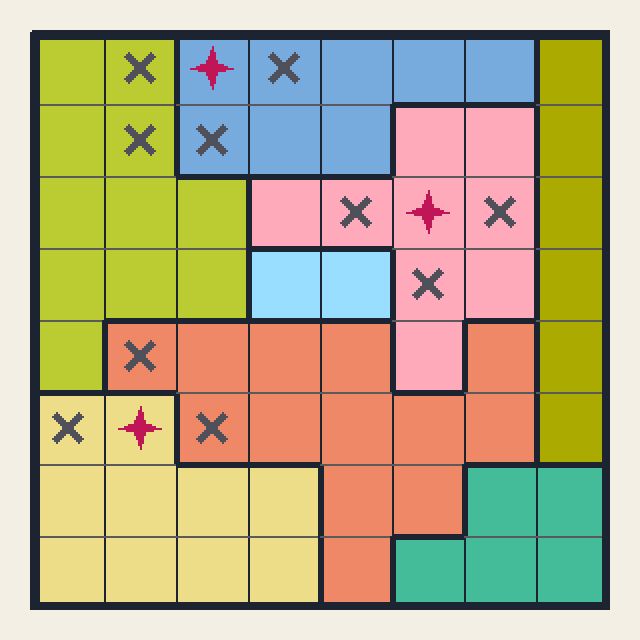
Regionle is a free daily region puzzle you can play right here in your browser. Every game day, at midnight in New York, a new 8×8 grid arrives, divided into colored regions. Place exactly one star in every row, every column, and every region, and keep those stars from touching — even diagonally. There is one unique solution. Finish this warmup to keep your streak; a second, classic star battle puzzle waits afterward if you want a full clear.
What is a daily region puzzle
A daily region puzzle is a logic grid with two layers of structure. The obvious layer is the familiar chessboard of rows and columns. The second layer is a partition of the same cells into regions: connected groups, each with its own color on Regionle. You are not coloring the map yourself. The regions are given, and your only marks are stars and the quiet crosses that say “this cell is empty.”
The one-star version on the Regionle home page is an 8×8 grid with eight regions. That size is intentional. It is long enough to feel like a real deduction, and short enough that a new player can finish it on a commute. We treat this grid as the day’s official warmup: completing it is what keeps a streak alive. The harder 10×10 two-star grid lives on its own page, as a star battle puzzle, so the two intents stay clear.
Every published daily region puzzle has exactly one solution, proved by an exact solver before the grid ever reaches the site. If a seed produced two legal star placements, it was discarded or repaired. You should never need to guess which of two “looks equally good” finishes is intended. If you ever feel forced to guess, a later deduction — a count on a row, a blocked region, or a single cell that would break two units at once — will resolve it.
The form is related to a family of star-placement grids that puzzle magazines have published for decades, and to the two-star “star battle” tradition in particular. Regionle’s daily region puzzle is the one-star, one-region-each cousin of that tradition. The same adjacency rule applies: stars are antisocial. They cannot sit in each other’s neighboring cells, including the diagonal neighbors, which is the same reach as a king in chess.
Because a new grid is published for everyone at the same moment, the daily region puzzle is also a shared appointment. Friends can compare times and whether they needed a hint without spoiling the star positions. The share card is built for that: it reports your time, your streak, and a tiny spoiler-free summary, never the board itself.
How to play
The board at the top of this page is today’s daily region puzzle. You do not need an account. Your first tap starts a timer that runs until the grid is accepted. Tap an empty cell to cycle it through three states: empty, a cross (this cell is not a star), and a star. If you would rather paint many crosses at once, drag across the board — a drag paints crosses only, so you cannot accidentally drop a star while sweeping a row.
Auto-X is on by default and is the friendliest way to learn. When you place a star, Auto-X marks every cell that can no longer hold a star: the eight neighbors, and, once a row, column, or region has its required star, the leftover cells in that unit. You can turn Auto-X off from the toolbar if you prefer to keep your own notes; turning it off never changes the underlying rules. Undo steps back one change. Clear removes every mark and leaves the timer running, so a fresh attempt is honest about time.
A hint asks the server for a single forced step based on your current marks. It does not download the solution, and it does not fill the rest of the board. If your marks already contradict the rules — two stars touching, or too many stars in a unit — the game will tell you that before a hint is useful. When every row, column, and region has its star and nothing is touching, the board is checked automatically. A correct finish is stored in this browser and counted for your streak.
After you finish, you can open today’s star battle puzzle, a 10×10 two-star grid, from the results card. That second grid does not replace this one and does not decide the streak. Completing both is a “full clear,” which is a personal extra, not a requirement. A new pair of puzzles arrives at midnight, America/New_York, for every player.
Rules
Four rules define the daily region puzzle, and they are all visible on the board once you know how to look.
First, place exactly one star in each of the eight rows. Second, place exactly one star in each of the eight columns. Third, place exactly one star in each region. Regions are the colored, 4-connected territories — cells that touch on an edge, not merely at a corner, belong to the same region when they share a color. A region can be a compact block or a winding snake; the shape changes from day to day, but the quota does not.
Fourth, no two stars may touch, including diagonally. If you imagine a star as a king in chess, no other star may sit on a square that king could move to. In practice this means that around every star there is a one-cell moat of empty cells. Those eight neighbors are excellent places for crosses, and Auto-X will fill them if you leave it on.
Those four constraints, taken together, are strong. An 8×8 one-star grid with eight regions and a king-separation rule does not have room for many legal configurations, which is why a uniqueness proof is realistic and why a short, careful deduction usually finishes the puzzle. There is no extra scoring rule, no hidden region, and no cell that is exempt. If a mark looks legal but the rest of the board falls apart, the mark was not actually forced — undo and look for a count you skipped.
Tips for the daily region puzzle
Start with the smallest regions. A region of two or three cells in a tight corner often has only one cell that can legally take a star once you respect the moat of a nearby placement, or even before any star is placed, if the region sits against already-blocked rows. A region that is a single long corridor is also friendly: stars cannot sit on adjacent cells, so you can mentally tick the cells that are impossible and see what remains.
Count in leftover space. If a row already has a star, the entire rest of that row is empty, and that information flows into the regions the row crosses. If a region must still place its star and only one of its cells sits in a row that is still open, that cell is forced. The same arithmetic applies to columns. Most “hard” looking moments on the daily region puzzle dissolve when you ask, for each unfinished region, “how many of my cells are still alive?”
Watch the diagonals. Players who grew up on rooks-only puzzles sometimes forget the corners. Two cells that do not share a row, column, or region can still be illegal together if they meet at a corner. When two unfinished regions lean against each other at a diagonal, placing a star in one can extinguish a cell in the other. That interaction is a feature, not a trick, and it is often the step that turns a messy middle into a forced finish.
Do not guess early. The published grid is unique, so a true fork — two placements that both seem possible — means you are missing a constraint. Use a trial only as a last resort, and only in your head or with undo: put a provisional star, follow the forced crosses, and see if a region is left with nowhere to go. If it is, the provisional star was wrong. The on-site hint is a depth-limited version of that idea: it returns one cell that can already be decided, and it will not narrate the rest of the solution.
Keep Auto-X on while you are learning, then try a day with it off if you want to practice seeing the moat yourself. Either way, the timer is only for your share card and your own curiosity. There is no penalty for thinking, and no leaderboard you must join to enjoy the daily region puzzle. If you want a slower tutorial of both modes, the how-to-play page walks through the same rules with the controls written out in one place. For a closer look at the one-star form itself, including how it differs from the two-star tradition, read the region puzzle rules.
FAQ
Is every daily region puzzle guaranteed to have one solution?
Yes. Each published grid is checked by an exact solver that proves there is exactly one legal placement of stars. If a generated layout has two solutions, it is not used.
When does the next daily region puzzle appear?
A new pair of puzzles is published at midnight in the America/New_York time zone. The countdown on this page is tied to that midnight, not to your local clock, so players around the world solve the same issue number.
Does finishing the star battle puzzle keep my streak?
No. Your streak is kept by finishing today’s one-star daily region puzzle on this page. The 10×10 star battle is optional. Completing both is a full clear, which is recorded on your share card but is not required to keep the streak.
Do I need an account?
No. Regionle is free in the browser. Progress, the timer, and your streak live in this browser’s local storage. There is nothing to sign up for, and you can play immediately.
What does a hint actually reveal?
A hint is computed on the server from your current marks and returns a single forced cell — a star that must go there, or a cell that must be empty. It never sends the full solution to the browser, and using a hint is noted on your share card.
Can two stars touch at a corner?
No. Stars may not touch on an edge or on a diagonal. The forbidden neighborhood is the eight cells around a star, the same reach as a king in chess.
Will the same grid be used for every player?
Yes. Everyone in the world gets the same daily region puzzle and the same star battle for a given game day. That is what makes a shared, spoiler-free share card meaningful.